

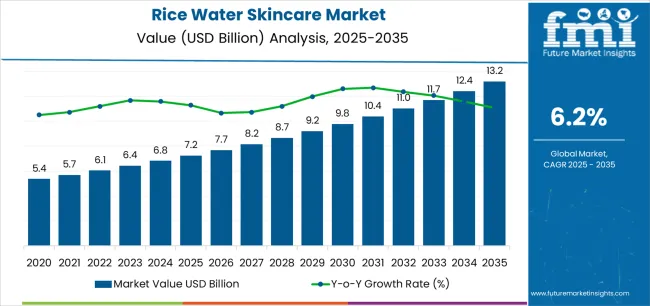
The rice water skincare market was valued at USD 7.20 billion in 2025. Based on Future Market Insights' analysis, demand for rice water skincare products is estimated to reach USD 7.65 billion in 2026 and USD 13.95 billion by 2036. FMI projects a CAGR of 6.2% during the forecast period.
| Metric | Details |
|---|---|
| Industry Size (2026) | USD 7.65 billion |
| Industry Value (2036) | USD 13.95 billion |
| CAGR (2026-2036) | 6.2% |
Source: Future Market Insights, 2026
Rice ferment filtrate and rice bran-derived actives are transitioning from niche K-beauty ingredients to mainstream formulation staples adopted by global personal care conglomerates. The dermatological validation of rice-derived compounds for brightening, barrier repair, and mild exfoliation has enabled premium pricing and clinical claims that separate rice water skincare from commodity botanical lines. E-commerce platforms are accelerating direct consumer education around fermentation-based actives, compressing the traditional product adoption timeline.
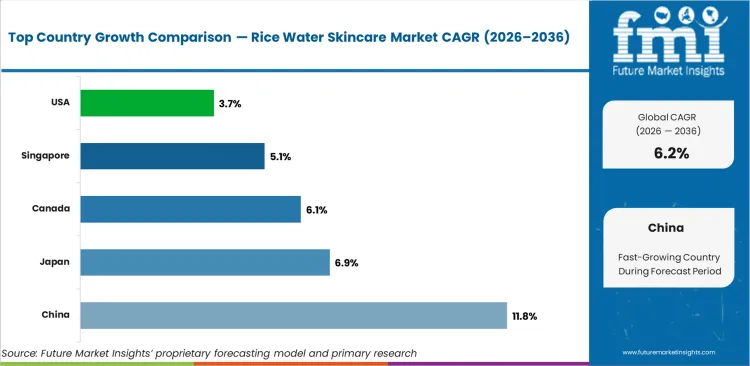
China leads at 11.8% CAGR, where domestic fermentation expertise, large-scale cosmetics manufacturing, and cultural familiarity with rice-based beauty drive adoption. Japan records 6.9% on the strength of its established J-beauty export infrastructure and rice bran cosmetics tradition. Canada tracks at 6.1%, reflecting growing clean beauty demand in North American markets. Singapore posts 5.1%, functioning as a distribution hub for Southeast Asian beauty retail. The United States records 3.7%, with adoption concentrated in specialty and online channels where ingredient-educated consumers drive purchasing decisions.
Rice water skincare encompasses topical cosmetic and dermatological products formulated with rice water, rice bran extract, or rice ferment filtrate as active ingredients. The category spans moisturizers, cleansers, toners, serums, and face masks. These products target brightening, hydration, and anti-aging benefits across multiple skin types and are distributed through mass retail, specialty beauty, pharmacy, and online channels.
Market scope includes moisturizers, cleansers, toners, serums, face packs/masks, and other skincare products containing rice water or rice-derived extracts. Coverage spans women, men, and unisex consumer segments with sales tracked across hypermarkets, specialty stores, pharmacies, convenience stores, and online retailers. Forecast data covers 2026 to 2036.
Rice water shampoos and hair care products are excluded from this scope. Ingestible rice-based supplements, rice-based body lotions not classified as facial skincare, and medical-grade dermatological preparations are also outside the valuation.
The below section shows the leading segment. Based on the product type, the moisturizers segment is accounted to hold a market share of 22.3% in 2026. Based on skin type, the dry skin segment is accounted to hold a market share of 18.9% in 2026.
The demand for moisturizers continues to upgrade as people become more aware of the importance of maintaining well-hydrated skin in preventing dryness, premature aging, and other skin concerns.
Rice water-based skincare products are known for their hydrating and soothing properties that offer a gentle and natural solution for addressing dry skin concerns.
| Category | Market Share in 2026 |
|---|---|
| Moisturizers | 22.3% |
| Dry Skin | 18.9% |
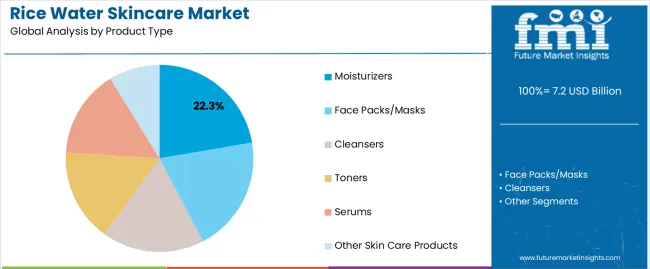
Based on product type, the moisturizer segment is accounted to hold a market share of 22.3% in 2026. Moisturizers are essential skincare products as they are designed for their hydration and nourishment of the skin, which is needed in daily skincare routines for consumers worldwide.
The popularity of moisturizers is attributed to their ability to address various skin concerns, including dryness, dullness, and premature aging.
Unique benefits like hydration, brightening, and soothing effects are offered by rice water-based moisturizers that are derived from the natural properties of rice water.
Products like these are particularly favored by consumers seeking gentle and natural substitutes to traditional moisturizers containing synthetic ingredients.
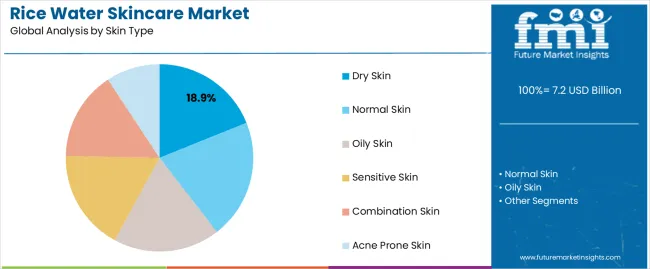
Based on skin type, dry skin is accounted to hold a market share of 18.9% in 2026. Dry skin is, nowadays, a common skincare concern due to lack of moisture and is often accompanied by flakiness, roughness, and tightness.
Rice water skincare products are formulated divinely for dry skin and offer targeted solutions that address such problems effectively. The hydrating and nourishing properties of rice water make it a quintessential ingredient for combating dryness and restoring the natural moisturizing barrier of the skin.
.webp "Top Country Growth Comparison Rice Water Skincare Market Cagr (2026 2036)")
The table mentions the top five countries ranked by revenue, with China holding the top position.
China dominates the rice water skincare market due to its rich cultural heritage and traditions incorporating rice water into beauty rituals. With a deep-rooted appreciation for natural ingredients and holistic skincare practices, consumers propel the demand for rice water-based products, pushing market dominance.
The Forecast CAGRs from 2026 to 2036
| Countries | CAGR until 2036 |
|---|---|
| United States | 3.7% |
| Canada | 6.1% |
| China | 11.8% |
| Japan | 6.9% |
| Singapore | 5.1% |
The rice water skincare market in the United States is primarily used in various skincare products such as cleansers, toners, moisturizers, and face masks. Consumers in the United States are turning to natural and organic skincare alternatives, and the popularity of rice water aligns well with this trend.
Rice water is commonly used as a facial cleanser and toner because of its gentle cleansing and brightening properties. Rice water-based moisturizers and face masks are widely used by consumers looking for skin hydration and nourishment of their skin while promoting a radiant complexion.
The rice water skincare market uses various skincare products catering to different skin concerns and preferences. The consumers of Canada are seeking anti-aging skincare products, inclusive of antioxidant properties, making them a popular ingredient in formulations that target fine lines and wrinkles.
The versatility of rice water thus incorporates a wide range of skincare products, making it a staple in the skincare market of Canada.
The market experiences rapid growth, with a CAGR of 11.8%, LED by consumer awareness and demand for natural skincare ingredients. Rice water is broadly used in various skincare products, including facial cleansers, toners, essences, and sheet masks.
Consumers value the traditional beauty practices used for centuries in the cultures of Asia for their skin-brightening and anti-inflammatory properties.
The rice water skincare market in Japan is deeply rooted in traditional beauty rituals across a wide range of skincare products. Rice water reflects its importance in the skincare routines of Japan, commonly found in facial cleansers, toners, lotions, and masks.
The consumers of Japan value the natural and nourishing properties of rice water, promoting smoothness and radiating skin while maintaining its moisture balance. Rice water-based products often incorporate traditional ingredients such as green tea, sake, and seaweed for enhanced skincare benefits.
With a CAGR of 5.1% by 2036, the market is moving in a rightward direction due to urbanization, rising disposable incomes, and thriving awareness of skincare trends.
The consumers of Singapore prioritize skincare products that address common concerns such as pollution-related damage, uneven skin tone, and dehydration, making rice water an attractive ingredient choice.
The multicultural population in Singapore contributes to the demand for skincare products catering to different skin types and preferences, further propelling the demand for the rice water skincare market.
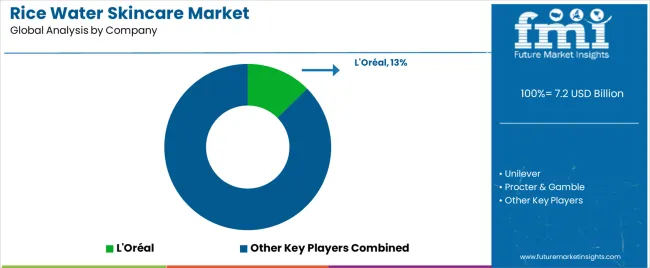
The competitive landscape of the rice water skincare market is described by a mix of established players and emerging brands vying for market share. Major companies leverage extensive distribution networks and brand recognition to maintain dominance, while smaller players focus on innovation and niche marketing strategies.
As consumer demand is directly proportional to natural skincare solutions grows, competition intensifies, driving ongoing product development and market expansion efforts.
Some of the key developments
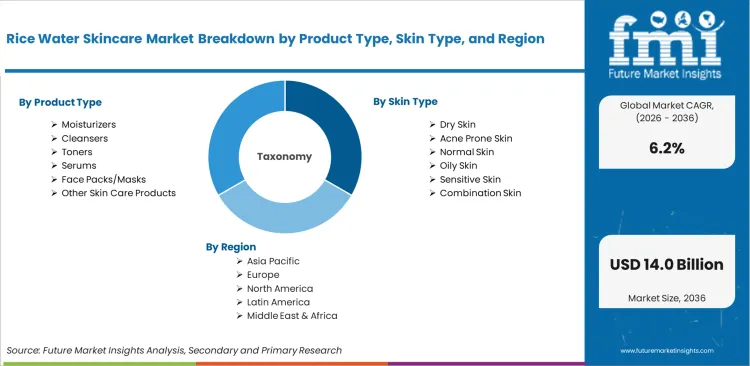
| Metric | Value |
|---|---|
| Quantitative Units | USD 7.65 billion to USD 13.95 billion, at a CAGR of 6.2% |
| Market Definition | Rice water skincare encompasses topical cosmetic and dermatological products formulated with rice water, rice bran extract, or rice ferment filtrate as active ingredients. The category spans moisturiz... |
| Product Type Segmentation | Moisturizers, Cleansers, Toners, Serums, Face Packs/Masks, Other Skin Care Products |
| Skin Type Segmentation | Dry Skin, Acne Prone Skin, Normal Skin, Oily Skin, Sensitive Skin, Combination Skin |
| Consumer Orientation Segmentation | Women, Men, Unisex |
| Sales Channel Segmentation | Hypermarkets/Supermarkets, Specialty Stores, Drug Stores & Pharmacies, Convenience Stores, Online Retailers, Other Sales Channel |
| Regions Covered | North America, Latin America, Europe, East Asia, South Asia, Oceania, Middle East & Africa |
| Countries Covered | China, Japan, Canada, Singapore, USA, and 40 plus countries |
| Key Companies Profiled | L'Oreal, Procter & Gamble, Unilever, Johnson & Johnson, Estee Lauder, Shiseido, Avon Products, Amorepacific Corporation, Kao Corporation, Beiersdorf, Colgate-Palmolive, Henkel AG & Co. KGaA, Coty Inc., Revlon |
| Forecast Period | 2026 to 2036 |
| Approach | Forecasting models apply a bottom-up methodology with cross-validation against quarterly enterprise revenue data. |
This bibliography is provided for reader reference. The full Future Market Insights report contains the complete reference list with primary research documentation.
How large is the demand for Rice Water Skincare in the global market in 2026?
Demand for Rice Water Skincare in the global market is estimated to be valued at USD 7.65 billion in 2026.
What will be the market size of Rice Water Skincare in the global market by 2036?
Market size for Rice Water Skincare is projected to reach USD 13.95 billion by 2036.
What is the expected demand growth for Rice Water Skincare between 2026 and 2036?
Demand for Rice Water Skincare is expected to grow at a CAGR of 6.2% between 2026 and 2036.
Which Product Type is poised to lead global sales by 2026?
Moisturizers accounts for 22.3% in 2026 based on FMI's analysis.
How is Dry Skin positioned within Skin Type in 2026?
Dry Skin holds 18.9% of segment share in 2026.
What is China's growth outlook in this report?
China is projected to grow at a CAGR of 11.8% during 2026 to 2036.
What does this market forecast represent?
The market forecast is a model-based projection built on defined industry and supply chain assumptions for strategic planning purposes. FMI applies a bottom-up methodology cross-validated against primary research and public financial disclosures.
What is included in the scope of this report?
Market scope includes moisturizers, cleansers, toners, serums, face packs/masks, and other skincare products containing rice water or rice-derived extracts.
Full Research Suite comprises of:

Market outlook & trends analysis
Interviews & case studies
Strategic recommendations
Vendor profiles & capabilities analysis
5-year forecasts
8 regions and 60+ country-level data splits
Market segment data splits
12 months of continuous data updates
DELIVERED AS:
PDF EXCEL ONLINE

Rice Water Skincare Market

Thank you!
You will receive an email from our Business Development Manager. Please be sure to check your SPAM/JUNK folder too.

